

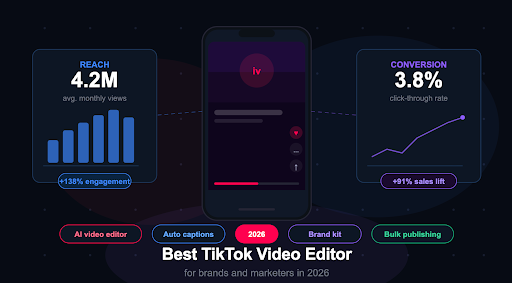
TikTok is no longer just a platform for viral dances and trending audio. It has become one of the most powerful channels for brand discovery, product marketing, and community building, particularly for businesses targeting audiences under 40. TikTok users now spend an average of 95 minutes per day on the app, and videos with dynamic captions and fast pacing see up to 55% higher completion rates. Buffer.
For brands and marketing teams, that kind of engagement is impossible to ignore. But capturing it consistently requires more than a good product or a clever idea, it requires video content that is edited well, published frequently, and aligned with how TikTok’s algorithm rewards attention. That starts with choosing the right tools.
This guide breaks down the best TikTok video editors available to brands and marketers in 2026, what to look for when evaluating them, and why AI-powered tools are quickly becoming the default choice for teams that need to produce at scale without sacrificing quality.
What Brands Actually Need from a TikTok Video Editor
Consumer creators and brand marketing teams have fundamentally different needs when it comes to video editing. A solo creator can afford to spend two hours on a single TikTok. A marketing team producing five to ten pieces of content per week cannot.
For brands, the non-negotiables are speed, consistency, and scalability. The editor needs to handle 9:16 vertical formatting automatically, support branded elements like fonts and color palettes, and reduce the manual effort involved in repetitive tasks, captions, voiceovers, music selection, without requiring a dedicated video editor on staff.
For consistent branding and faster content creation, the right tools should offer templates, presets, and automation features invideo that make it possible to maintain a recognizable visual identity across every video, regardless of who on the team is doing the editing.
Beyond that, brands increasingly need AI capabilities, not as a novelty, but as a genuine workflow accelerator. The ability to generate a TikTok from a script, a brief, or even a product description is no longer a futuristic concept. It is available right now, and it is changing how fast-moving marketing teams operate.
1. Invideo – Best AI TikTok Video Editor for Marketing Teams
Invideo is the strongest option for brands that want to produce high-quality TikTok content quickly and consistently without deep video editing expertise. As a purpose-built AI TikTok video editor, it takes a prompt, script, or content brief and generates a fully produced TikTok, complete with AI voiceover, auto-captions, background music, and stock visuals, in minutes.
What sets invideo apart for marketing use cases is the combination of speed and control. The platform offers 50+ style workflows tailored to different content formats and brand tones. Its Magic Box editor lets team members make changes using plain-language commands, “change the voiceover accent,” “make this scene shorter,” “add a CTA at the end”, without touching a timeline. And with access to over 16 million stock media assets, sourcing visuals for product-focused or industry-specific content is rarely an obstacle.
For brands managing consistent TikTok output, invideo removes the two biggest friction points: the time required to edit manually and the skill barrier that limits who on a team can produce video. Any marketer, social media manager, or content strategist can operate it effectively from day one.
Best for: Marketing teams, social media managers, and brands that need consistent TikTok output without a dedicated video editor.
2. CapCut – Best for Teams Comfortable with Manual Editing
CapCut remains the most widely used third-party TikTok editor, and for good reason. It offers smart editing features including chroma key, keyframe animation, and multi-layer editing, alongside AI tools like auto captions, background remover, and text-to-speech, all within a template library of thousands of TikTok-ready formats with music synced to beat markers. Ttbusiness
For brand teams with some editing experience, CapCut offers a strong balance of power and accessibility. Its direct TikTok publishing integration and native 9:16 support make the production-to-publish workflow straightforward. The limitation is that it still requires meaningful manual input, it is not a tool you hand to a copywriter or account manager and expect results without a learning curve.
Best for: In-house creative teams and social media managers with hands-on editing experience.
3. Adobe Premiere Pro + Adobe Express – Best for Enterprise Brands
For established brands and agencies managing large-scale campaigns, Adobe’s dual-tool approach remains a benchmark. Premiere Pro handles detailed work on color, audio, and motion graphics, while Adobe Express simplifies the process for social-first edits and resizing, with the Auto Reframe feature intelligently converting horizontal footage to TikTok’s 9:16 vertical format. Buffer
The Adobe ecosystem is built for collaboration, integrating Frame.io for review and approval workflows and offering shared Creative Cloud Libraries for brand assets. Buffer For enterprises with dedicated creative teams and complex approval processes, this infrastructure is hard to replace.
The tradeoffs are cost and complexity. Adobe Creative Cloud is a significant investment, and Premiere Pro’s learning curve makes it inaccessible for non-editors on a marketing team. It is a professional tool that produces professional results, but it is overkill for most brand TikTok operations.
Best for: Large brands and agencies with dedicated creative teams producing high-production video content.
4. Canva – Best for Brand Consistency on a Budget
Canva has become a powerful tool for quick, template-driven video creation, excelling at combining video clips with branded elements, animated text, and stock media, all within an intuitive drag-and-drop interface. Its Brand Kit feature lets marketing teams upload logos, set fonts, and lock brand colors. Ttbusiness
For smaller brands or teams without video production experience, Canva is an approachable starting point. It will not produce cinematic results, but it reliably produces clean, on-brand content at speed. Its main limitation is depth, Canva’s video capabilities are secondary to its design roots, and it shows when you need anything beyond basic editing.
Best for: Small marketing teams and startups that prioritize visual brand consistency over advanced video features.
5. Kapwing – Best for Collaborative Teams
Kapwing is built for social media managers and brands who need a fast, accessible, browser-based tool for turning raw footage or long-form content into polished TikToks. Its strength lies in combining template-driven editing with robust collaborative features like shared workspaces and review links. Glimpse
For distributed marketing teams working across time zones, Kapwing’s browser-based approach removes the hardware and software dependencies that slow down traditional editing workflows. AI-powered auto-subtitling, automatic translation, and a Brand Kit for maintaining visual consistency make it a solid option for teams managing content across multiple markets. Glimpse
Best for: Remote marketing teams and agencies managing multi-market TikTok content that requires real-time collaboration.
How to Choose the Right TikTok Video Creator Tool for Your Brand
With so many options available, the decision ultimately comes down to four questions.
How much video do you need to produce? If your team is publishing three or more TikToks per week, manual editing tools will become a bottleneck quickly. AI-powered TikTok video maker tools like invideo are built for this kind of volume.
Who on your team will be doing the editing? If the answer is “whoever has time,” you need a tool with a low skill floor. Dedicated editors can use CapCut or Premiere Pro effectively; non-editors need something closer to invideo or Canva.
How important is brand consistency? For brands with strict visual guidelines, look for tools with Brand Kit features, locked templates, or style workflows that enforce consistency without requiring manual intervention on every video.
What is your budget? The range runs from free (CapCut, Canva basic) to enterprise-level subscriptions (Adobe Creative Cloud). AI tools like invideo offer a free tier to start, with paid plans unlocking watermark-free exports and advanced features.
Why AI TikTok Video Editors Are Winning for Brand Marketing
The shift toward AI-powered editing tools is not a trend driven by novelty, it is a response to a genuine operational problem. Marketing teams are expected to produce more content, faster, with the same or fewer resources. Traditional editing workflows, even with experienced editors, do not scale easily to the pace TikTok demands.
The best AI video editors in 2026 can reframe horizontal footage for vertical output, clean background noise, improve speech clarity, generate captions, identify speakers, and in some cases support dubbing and translation. DesignRush These are tasks that used to require multiple tools, multiple people, or both.
For brands specifically, the ability to generate a TikTok from a content brief, without filming, without manual editing, and without a specialist on call, changes the economics of social video entirely. A campaign that previously required a videographer, an editor, and a post-production review cycle can now be executed by a single marketer in under an hour.
Invideo’s approach captures this well. Rather than replacing editors with automation, it removes the parts of the workflow that didn’t require creativity in the first place, formatting, captioning, music selection, voiceover recording, and gives marketers back the time to focus on strategy, messaging, and distribution.
Final Thoughts
The best TikTok video editor for your brand is the one that fits your team’s workflow, not the one with the longest feature list. For most marketing teams in 2026, especially those without dedicated video production resources, the answer increasingly points toward AI-powered tools that prioritize speed, consistency, and ease of use over technical depth.
If you’re building a TikTok content operation that needs to scale, invideo’s AI TikTok video editor is worth starting with. The free plan is enough to test the workflow, and the output quality competes with what most brand teams are producing manually, in a fraction of the time.